
Purpose-built tooling for authorized security assessment, from the CyberDagger internal toolchain.
The Problem With Off-the-Shelf
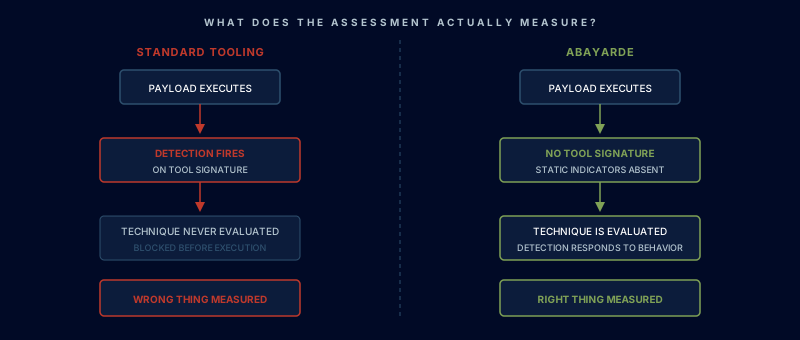
Modern endpoint detection platforms have broad coverage of common testing patterns. Import table scanning, string analysis, behavioral telemetry, and call stack enumeration are standard detection mechanisms, and the tools most assessors rely on have been profiled against these mechanisms long before they reach a client environment. The result is a gap between what a test attempts and what it actually exercises.
The meaningful question in an authorized engagement is not whether a tool can run, but whether the test accurately represents the threat. When detection fires on the tool’s own signature rather than the technique under evaluation, the engagement has measured the wrong thing.
Abayarde is CyberDagger’s response to that problem. The name comes from the abayarde, Wasmannia auropunctata, the little fire ant native to the Caribbean: small, invasive, and consequential before it is noticed.
A Recurring Pattern
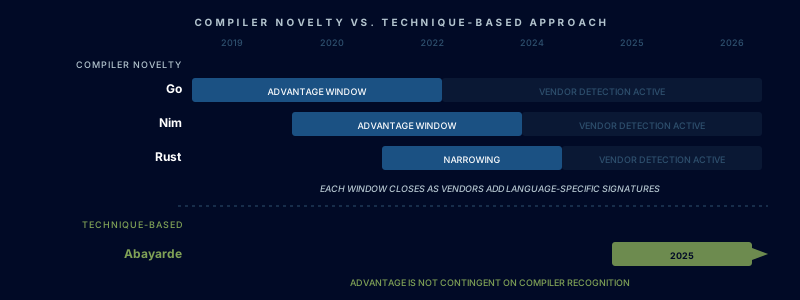
The same dynamic has played out at least three times in the past decade. A compiled language is adopted for assessment work because its binary characteristics are unfamiliar to detection stacks built around C and C++ artifacts. Detection rates fall, vendors respond by building language-specific signatures and updating behavioral models, and the advantage closes. Each cycle lasted roughly two to three years.
The teams that adopted those languages were not wrong to do so. However, tooling designed around compiler novelty is built on a depreciating asset. By the time the tooling is standardized and in production use, the window has typically already begun to close.
The premise behind Abayarde is a different framing of the problem. Compile-time API hashing removes string artifacts independent of whether the compiler is recognized. String encryption bounds the plaintext lifetime of sensitive values to their point of use, regardless of section layout. Syscall delivery bypasses userland hook surfaces regardless of signature corpus maturity. These are technique decisions, not claims of novelty, and their effectiveness is not contingent on vendor unfamiliarity with the compiler.
What It Is
Abayarde is a compiled language designed for assessment payload development on Windows and Linux. Its purpose-built native compiler produces standalone executables with no dependency on LLVM, GCC, or any external toolchain. The compiled output has no runtime dependency and no C runtime requirement. Detection surface management is a property of the language itself rather than a post-compilation step.
The primitives relevant to authorized assessment work, including API resolution, string handling, syscall delivery, and binary profiling, are first-class language features. The assessor specifies intent; the compiler produces the corresponding output.
Capability Overview
These capabilities can be implemented in any compiled language. Abayarde was designed with OPSEC and tradecraft primitives built in from day one, not adapted after the fact from a general-purpose toolchain.
- The compiled output carries no signatures a static classifier can use.
- The payload operates independent of common instrumentation surfaces.
- Execution is conditioned on the target environment.
- The binary’s observable profile is controlled at compile time.
Why a Language
The practical alternative is a set of per-engagement C or assembly stubs assembled by hand. This approach is functional and widely used. The limitation is consistency: technique implementations vary between assessors, detection surface decisions are made without a common standard, and pre-engagement tooling review is a recurring manual cost.
A language with these capabilities built in provides a consistent baseline. Every payload produced by any assessor on the team reflects the same compile-time decisions. Engagements proceed faster because the supporting infrastructure does not need to be rebuilt, and the source remains auditable by anyone on the team.
Abayarde is deployed within CyberDagger’s CATM Breach and Attack Simulation platform and our Red Team operations toolchain.
If your organization runs authorized security assessments and the accuracy of those assessments matters, we would like to hear from you. Get in touch.